 R-U-Known
 • AI Visibility Knowledge Hub
AI Brand Mentions: How to Track When AI Recommends Your Brand — and When It Recommends Competitors Instead
An AI brand mention is any identifiable appearance of a brand in an AI-generated answer. But not all mentions mean the same thing. A brand can be listed incidentally, described in detail, cited as a source, compared with a competitor or actively recommended as a solution.
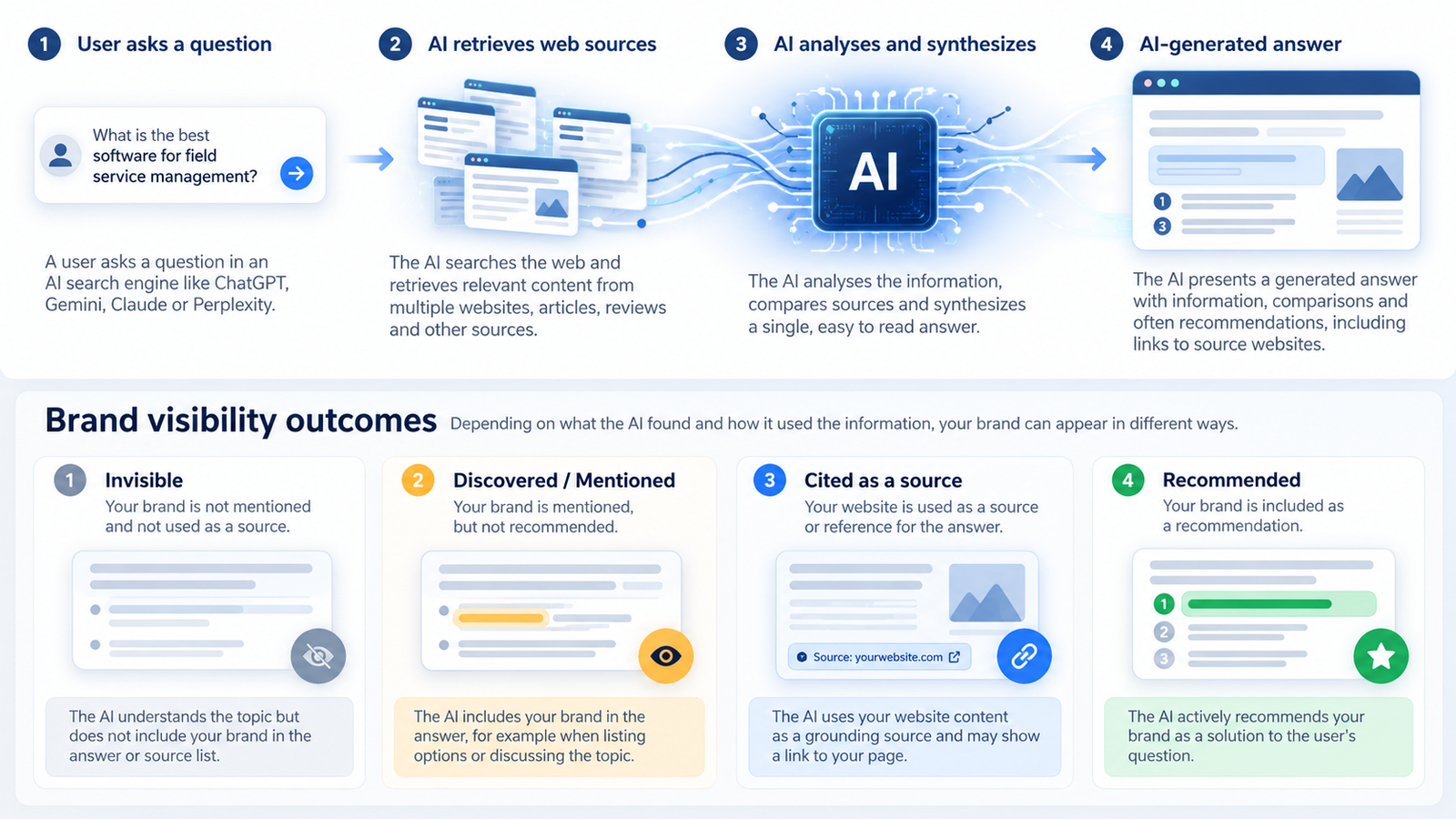
Five types of brand evidence
| Evidence type | Example | Interpretation |
|---|---|---|
| Invisible | The answer discusses the category but never identifies the brand. | No direct brand visibility for that prompt. |
| Incidental mention | The brand appears in a long list. | Awareness, but weak evidence of preference. |
| Descriptive mention | The answer explains what the product does. | Stronger entity/category understanding. |
| Citation/source | The brand's website supports a factual statement. | Source authority; not automatically a product recommendation. |
| Recommendation | The brand is presented as a suitable solution. | High-value visibility for the question being asked. |
Why counting mentions alone can mislead you
Imagine Brand A appears 20 times, mostly in generic lists. Brand B appears only 12 times but is recommended in eight decision-stage questions. A simple mention count would declare Brand A more visible while ignoring the context that may matter more commercially.
Likewise, a brand can be mentioned negatively or inaccurately. AI visibility tracking therefore needs the original answer, not just a counter.
Track competitors in the same answer
Turn an absent mention into useful intelligence
Which problem is the user trying to solve?
Was your brand present?
Who appeared instead?
What evidence supported them?
What useful information is missing or weaker?
Competitor visibility is most useful when attached to the prompt that produced it. If a rival repeatedly appears for “best software for multi-location inventory” while your brand does not, that is more actionable than a generic competitor leaderboard. It identifies the topic where the web and AI system currently associate the rival more strongly.
AI brand mentions and sentiment
Sentiment can add context, but it should be used carefully. Generated answers are not customer reviews. A model may summarize third-party information, hedge its wording or mix positive and negative attributes. Store the evidence and explain why a mention was classified rather than presenting an opaque positive/negative score as unquestionable truth.
What if the AI says something wrong?
Incorrect AI brand mentions are a separate problem from invisibility. First determine whether the error comes from your own site, stale third-party pages, ambiguous naming or unsupported generation. Correct authoritative first-party information where necessary and make important facts easy to verify. Where a third-party source is wrong, pursue a legitimate correction rather than trying to manufacture signals.
Why source authority matters
Pew's 2025 study found that 88% of the Google AI summaries it observed cited at least three sources. Wikipedia, YouTube and Reddit together represented 15% of the sources listed in those summaries, while government sites were proportionally more common among AI-summary sources than among standard search-result sources. The broader lesson is not “get onto those three sites at any cost.” It is that generated answers can synthesize multiple parts of the information ecosystem.
How to improve AI brand mentions without keyword stuffing
- Answer unbranded questions. Become useful before the reader already knows your name.
- Use consistent entity language. Make the company, product, category and core capabilities unambiguous.
- Publish original evidence. Benchmarks, methodology, case studies and first-hand data give other pages — and potentially retrieval systems — something concrete to reference.
- Create fair comparisons. Explain differences and trade-offs rather than declaring yourself the winner in every scenario.
- Monitor the result. Use repeatable prompts to see whether visibility, source usage and competitive context actually change.
From brand mentions to generative engine optimization
Generative engine optimization should use mention data as feedback, not as a vanity metric. If the brand is invisible for a question, inspect what the answer discusses and what sources it uses. If it is mentioned but misunderstood, improve clarity. If it is cited but never recommended, investigate whether the available information clearly connects the product to the use case. Then measure again.
Frequently asked questions
What counts as an AI brand mention?
An explicit identification of the brand in the generated answer. Source retrieval should be tracked separately because a website can support an answer without the brand itself being mentioned.
Is being cited better than being mentioned?
They indicate different things. Citation can signal source usefulness; a mention signals entity presence. A recommendation is another distinct outcome. Good reporting preserves all three.
How can I find prompts where competitors appear but my brand does not?
Build an unbranded benchmark around category, problem, comparison and decision questions, then record target and competitor entities for every response. Those “competitor present / target absent” prompts are often the most actionable content gaps.