 R-U-Known
 • AI Visibility Knowledge Hub
AI Search Monitoring vs Traditional SEO Monitoring: What's the Difference?
SEO monitoring asks where pages rank and what traffic they earn. AI search monitoring asks what generated answers say, whether your brand appears, which competitors are surfaced and which sources shape the response. The two disciplines overlap, but they measure different parts of discovery.
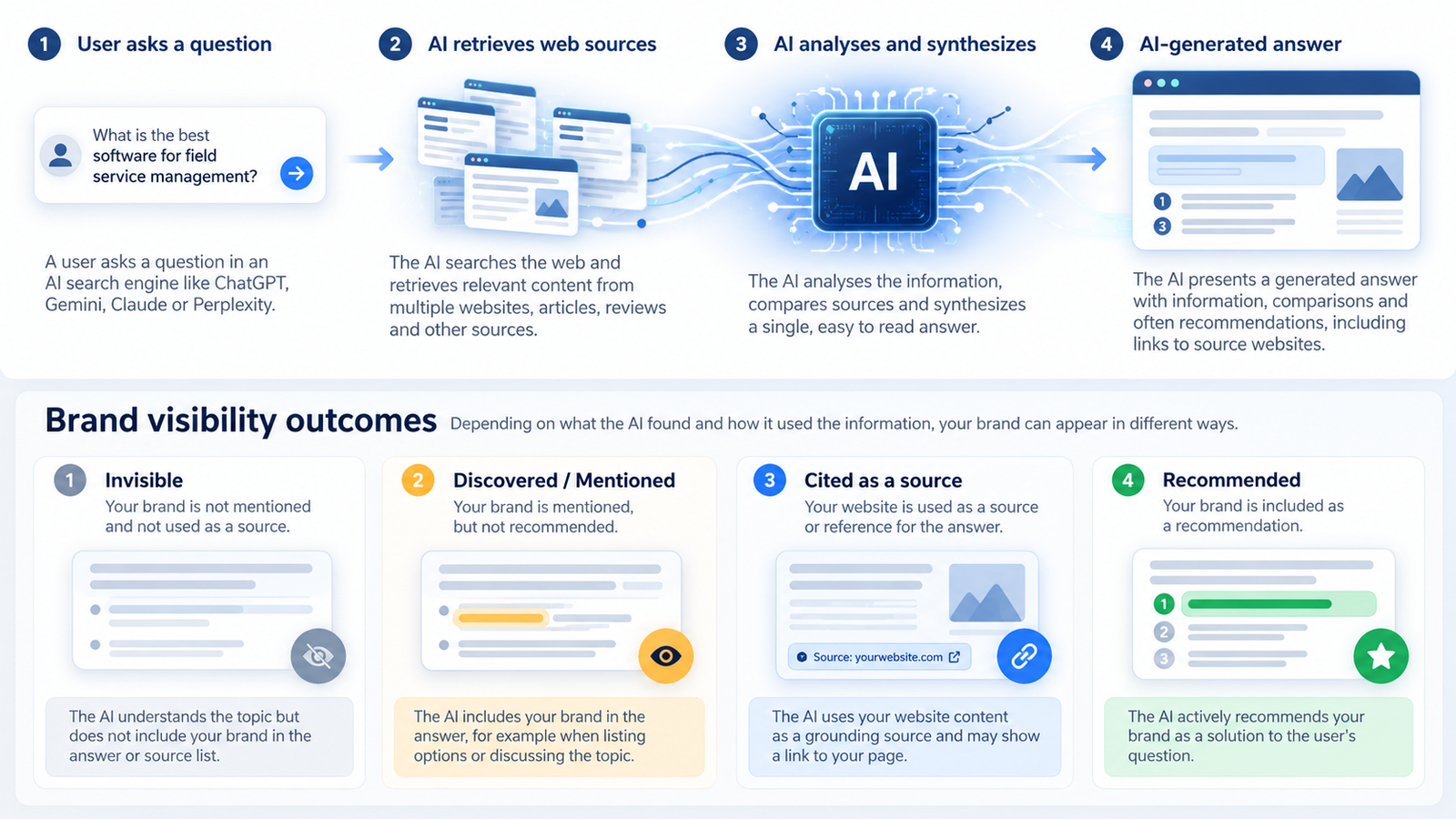
The simplest difference
| Traditional SEO monitoring | AI search monitoring |
|---|---|
| Tracks keyword rankings | Tracks answers to relevant questions |
| Measures URLs and SERP positions | Measures brand presence, context and recommendation |
| Tracks organic clicks and impressions | Tracks mentions, citations and source influence |
| Compares competing domains | Compares competing brands inside answers |
| Usually expects a visible ordered result set | Works with synthesized, variable responses |
| Optimizes pages for search discovery | Evaluates whether AI systems understand and surface the entity |
Why SEO data alone can miss the AI answer layer
A page can rank well and still not be used in the generated response. Conversely, a source can contribute to an AI answer even when the user never clicks it. Pew's 2025 click analysis illustrates the behavioural shift: on observed Google visits with an AI summary, users clicked traditional search results less often than on visits without one.
This does not make traffic irrelevant. It means marketers need visibility data before the click as well as analytics after it.
What should AI search monitoring watch?
A practical monitoring loop
Run stable, relevant questions.
Store answers and citations.
Detect target, competitors and recommendation.
Review sources, context and accuracy.
Measure against a frozen benchmark.
Improve content where evidence shows a gap.
Brand presence
Was the company absent, mentioned, cited or recommended? These should not be collapsed into one binary “found/not found” field.
Competitor presence
If a competitor appears repeatedly for an unbranded use case, that tells you something about category association and available web evidence.
Source influence
Record the domains and pages that the AI system exposes as grounding or supporting sources. Source evidence is particularly useful because it can suggest what information ecosystem is shaping the answer.
Answer accuracy
Monitoring should flag outdated or invented product facts. Visibility is not automatically positive if the model is confidently wrong.
Where generative engine optimization fits
Generative engine optimization is the improvement work; AI search monitoring is part of the measurement. You might improve a product page, publish original research, clarify category language or earn authoritative third-party coverage. Monitoring then tests whether relevant generated answers changed.
Google cautions against treating GEO as a bag of special hacks. Its 2026 guidance says unique, valuable content and established SEO fundamentals remain central, while tactics such as unnecessary AI text files or inauthentic mentions should not be the focus.
When should you use SEO monitoring, AI monitoring, or both?
| Question | Best starting data |
|---|---|
| Did our organic traffic fall? | SEO/search analytics |
| Does Gemini mention our company for this problem? | AI search monitoring |
| Which page ranks for this keyword? | SEO rank tracking |
| Which competitors are recommended by AI? | AI visibility tracking |
| Which websites are shaping the generated answer? | AI citation/source evidence |
| Are our content changes improving overall discovery? | Both |
Frequently asked questions
Will AI search monitoring replace rank tracking?
No. They answer different questions. Search rankings, impressions and traffic remain important; AI monitoring adds visibility into generated answers.
Why can AI answers change between runs?
Models and retrieval systems are dynamic. Answers can vary with prompt wording, model updates, source freshness and other context. That is why stable benchmarks and evidence retention matter.
Does Google require special GEO markup?
Google says there are no additional technical requirements for appearing in AI Overviews or AI Mode beyond eligibility for Search and established best practices.