 R-U-Known
 • AI Visibility Knowledge Hub
AI Search Visibility: How to Measure Whether AI Search Engines Know Your Brand
AI search visibility describes how often, where and in what context a brand appears in AI-generated search experiences. A brand can rank well in traditional search and still be absent from a generated answer — which is why visibility needs to be measured directly.
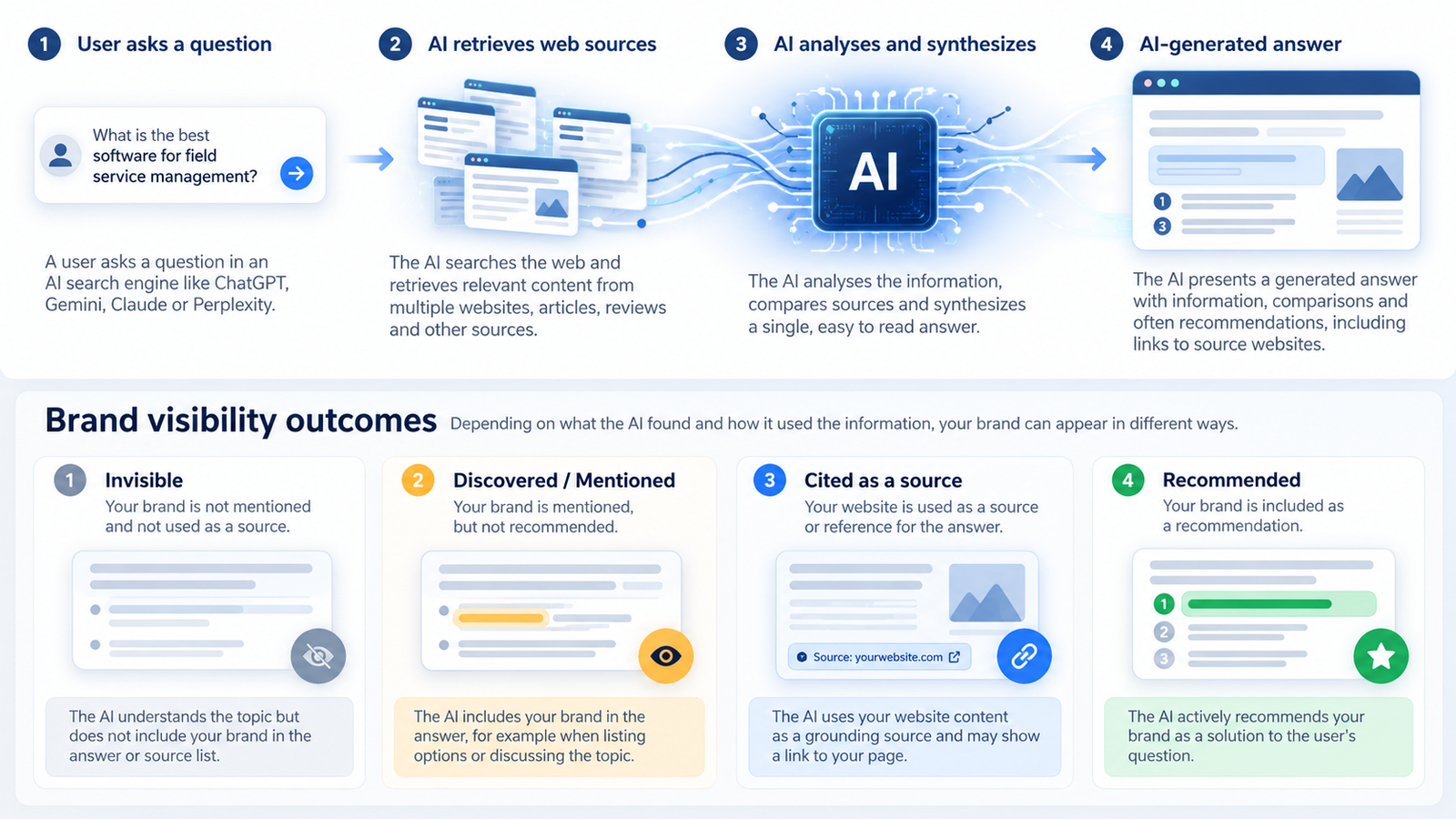
AI visibility is not a traditional ranking
In a conventional search result, position is visible: a page may be first, fifth or on page two. Generated answers are different. They synthesize information. A brand can be named without a link, cited without being recommended, recommended without occupying a numbered “position,” or omitted while competitors appear.
This means a useful measurement system must preserve context. “We were mentioned 12 times” tells you much less than “we were recommended in four purchase-intent questions, cited in three educational answers, and absent from five comparison questions where two competitors appeared.”
Four outcomes worth separating
| Outcome | What it means | Why it matters |
|---|---|---|
| Invisible | The target brand is not present in the answer and its site is not identified as a supporting target source. | Shows a discovery or relevance gap for that question. |
| Mentioned / discovered | The answer identifies the brand but does not recommend it. | Shows entity awareness without endorsement. |
| Cited / sourced | The website contributes supporting information. | Shows source authority, which is different from a recommendation. |
| Recommended | The answer presents the brand as a suitable option or solution. | Shows visibility at a high-intent decision point. |
Why this matters even when AI sends fewer clicks
Pew's analysis of 68,879 Google searches found that users clicked a traditional result on 8% of visits when an AI summary appeared, compared with 15% when one did not. Links inside the AI summary itself were clicked in only 1% of visits with a summary. That makes brand representation inside the answer strategically important: sometimes the answer itself is where the user forms an impression.
What should an AI visibility benchmark contain?
A balanced prompt benchmark
What tools or companies exist?
How can I solve this problem?
Which options differ and how?
What should I consider before choosing?
What is known about this company?
A benchmark should reflect how people actually research the category. Do not build it entirely from branded questions; that only tests whether the system can repeat what it already knows when prompted with the name. Include unbranded discovery questions, use-case questions, comparisons and decision-stage prompts.
Measure context, not just counts
A strong AI visibility tracking workflow records the question, model/provider, answer, target-brand status, competitors, cited sources and evidence. It should also distinguish deterministic facts from model interpretation. Whether a target hostname appears in supplied citations is a factual check; the tone or framing of the mention may require interpretation.
This distinction matters because AI systems can hallucinate. A monitoring platform should not let a generated analysis invent evidence that the underlying answer or citations do not contain. Evidence claims should be validated against the stored response and source data.
AI search visibility vs website traffic
Traffic remains important, but it answers a different question. Analytics tells you who arrived. AI search visibility tells you what happened before the click — including cases where no click occurred. Together they reveal whether AI engines are becoming a discovery layer for the brand and whether that visibility produces downstream engagement.
How to improve AI search visibility
Start with useful, original content and technical accessibility. Google's current guidance specifically recommends unique, non-commodity, people-first content and says established SEO practices remain foundational. Make your entity and offering clear, publish pages that directly answer relevant questions, support claims with evidence, keep important facts consistent, and earn legitimate third-party recognition rather than manufacturing mentions.
Frequently asked questions
What is a good AI visibility score?
There is no universal score. A useful baseline is your own stable benchmark: measure the same relevant question set over time and compare like with like.
Is a citation the same as a recommendation?
No. A site can be used as a source while another brand is recommended. Source authority and product recommendation should be tracked separately.
How often should AI visibility be measured?
Use a cadence that can reveal meaningful change without reacting to normal answer variability. For many businesses, scheduled benchmarks plus targeted checks after major content or product changes are more useful than obsessing over daily noise.