 R-U-Known
 • AI Visibility Knowledge Hub
AI Tracker: What You Should Measure Beyond Rankings and Website Traffic
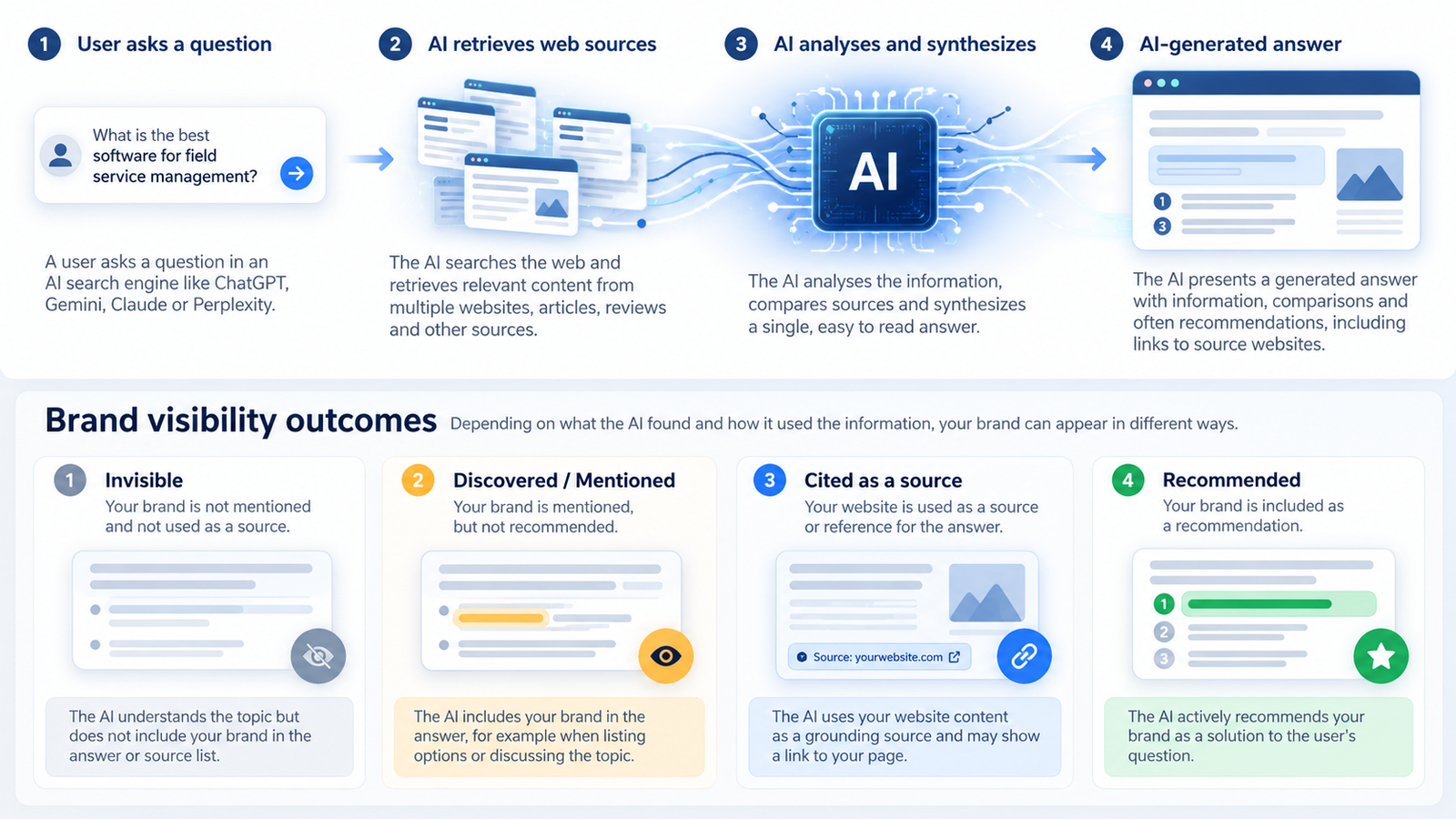
An AI tracker measures how a brand appears across AI-generated answers. The goal is not simply to count mentions. It is to understand where the brand appears, how it is framed, what sources influence the answer, which competitors appear, and how those patterns change over time.
The six measurements that make a benchmark useful
From prompt to actionable evidence
The exact question asked.
Invisible, mentioned or recommended.
How the brand is described.
Who appears alongside or instead.
Which pages ground the answer.
What changed vs a comparable benchmark.
1. Mention frequency
How often does the target appear across the benchmark? This is the simplest measure, but it should be split by prompt type. Ten mentions on branded prompts are not equivalent to ten mentions on unbranded category questions.
2. Recommendation frequency
A recommendation is stronger than an incidental mention. Track it separately so a rise in casual references does not look like an increase in purchase-intent visibility.
3. Competitive share of voice
When the target is absent, who appears instead? This turns an “invisible” result into useful competitive intelligence and can reveal categories or use cases the market associates more strongly with competitors.
4. Citations and source pages
Which domains and pages are used to support the answer? Source tracking can expose an authority gap even when the target brand itself is not mentioned. It can also reveal which third-party publications, directories, forums or first-party pages repeatedly shape the category narrative.
5. Context and accuracy
A mention can still be wrong. Track whether the answer describes the product accurately, associates it with the right category, invents capabilities or relies on stale information.
6. Movement over time
A benchmark becomes far more useful when it is frozen and repeatable. Compare the same question set and preserve the provider/model context where possible. Otherwise, apparent “growth” may simply reflect a changed test.
Why a frozen benchmark matters
AI answers vary. If the question set changes every week, you cannot tell whether the brand changed or the test changed. A frozen benchmark creates a consistent measuring stick. New exploratory questions can still be tested, but they should not silently rewrite the historical baseline.
What an AI tracker measures vs SEO rankings
| Metric | SEO tracking | AI visibility tracking |
|---|---|---|
| Unit measured | Keyword + URL position | Question + generated answer |
| Brand outcome | Page ranked or not | Invisible, mentioned, cited, recommended |
| Competitor view | Competing domains in SERPs | Brands appearing in the synthesized answer |
| Evidence | Ranking URL | Answer text + citations + source roles |
| History | Rank movement | Visibility and narrative movement |
Do not confuse model interpretation with evidence
For domain matching, normalize URLs and compare hostnames rather than using loose substring checks. A monitoring system should also preserve the original response and citations so every conclusion can be audited.
What does a useful AI visibility report answer?
- Which questions currently make the brand invisible?
- Where is it merely mentioned versus actively recommended?
- Which competitors repeatedly occupy the missing positions?
- Which external pages are influencing those answers?
- Does the AI understand the company's category and capabilities correctly?
- Which changes are persistent across comparable benchmarks rather than one-off answer variation?
Turn tracking into a GEO feedback loop
Generative engine optimization without measurement easily becomes guesswork. Tracking closes the loop: identify a visibility gap, inspect the evidence, improve the information available on your site and elsewhere, then re-run the same benchmark. If visibility changes, inspect exactly where and why before attributing the result to a single content change.
Frequently asked questions
What is an AI tracker?
An AI tracker monitors how AI-generated systems answer defined customer questions. A useful AI visibility tracker records whether a brand is invisible, mentioned, cited or recommended, along with competitors, sources and changes over time.
Is AI visibility tracking the same as social listening?
No. Social listening observes human conversations on social platforms and the web. AI visibility tracking tests how AI-generated systems answer defined questions and which brands and sources appear in those answers.
Should every AI model be tracked?
Not necessarily. Coverage should match the audience and decision you are trying to make. A smaller, consistent benchmark on relevant engines can be more actionable than broad but noisy coverage with no stable methodology.
Can one benchmark prove a GEO change worked?
It can show a changed observation, not necessarily causation. Repeated comparable measurements and evidence review are safer than attributing every movement to the latest edit.