 R-U-Known
 Case Study
From Invisible to Recommended: A Practical Method for Measuring AI Visibility
When someone asks an AI system, “Who should I use?”, does your business appear? More importantly, does the AI actually recommend you — or merely know that you exist?
Search is changing. People are increasingly asking AI systems questions that they once asked Google: who should I use, which company is best, what solution should I choose, who serves my area, and which provider would you recommend?
That creates a new visibility problem for businesses.
Being present somewhere on the web does not necessarily mean an AI system will find your business. Being found does not necessarily mean it will recommend you. And being recommended once does not tell you whether the result is repeatable.
That is why simply measuring “AI visibility” as one percentage can leave out much of the story.
If real customers ask AI questions about a business, what happens?
Start with the questions customers actually ask
A traditional keyword list starts with search terms. We wanted a different starting point.
R-U-Known begins with the business itself: what the company does, what it sells or provides, who it serves, where it operates, and what it wants customers to find it for.
That context is combined with website research to create a set of real-world discovery questions. The goal is not to manufacture a list of convenient keywords. The goal is to model the situations in which a potential customer might actually turn to AI for help.
For example, a field service management company might be tested with questions around job cards, scheduling, field technicians, inventory, quotations, or choosing software for a service business.
The resulting questions form a benchmark.
Why 50 questions?
A single prompt can be misleading. An AI system may recommend a company for one question and ignore it completely for another.
A broader benchmark gives us a more useful picture.
R-U-Known uses a locked 50-question benchmark so that later runs can be compared against the same test. That matters because a change in the result should ideally reflect a change in AI visibility — not simply a different set of questions.
The benchmark is an investigation, not just 50 prompts
The benchmark is designed as an evolving investigation.
Start with real-world questions people might ask when looking for businesses, products, or solutions like the one being tested.
Use what AI actually found — and missed — in the first stage to investigate deeper. This helps uncover areas where the business may be poorly represented, misunderstood, or absent.
Move beyond simple discovery and examine the questions where a customer is effectively asking AI: “Who should I use?”
This distinction is important. A company can be discoverable without being competitive in an AI recommendation.
Invisible, Discovered, Recommended
One of the simplest ways to communicate the result is to separate AI visibility into three states.
AI did not retrieve the business for the question.
AI found the business, but did not recommend it.
AI included the business as a recommendation.
This makes a major difference to how the results are interpreted.
Suppose a company receives a 20% recommendation rate. That number is useful, but it becomes much more meaningful when we can see the underlying distribution: how many questions produced no discovery, how many resulted in discovery without recommendation, and how many actually produced a recommendation.
Example: measuring change instead of just reporting a score
Here is an example from an R-U-Known benchmark for ExequtechOS.
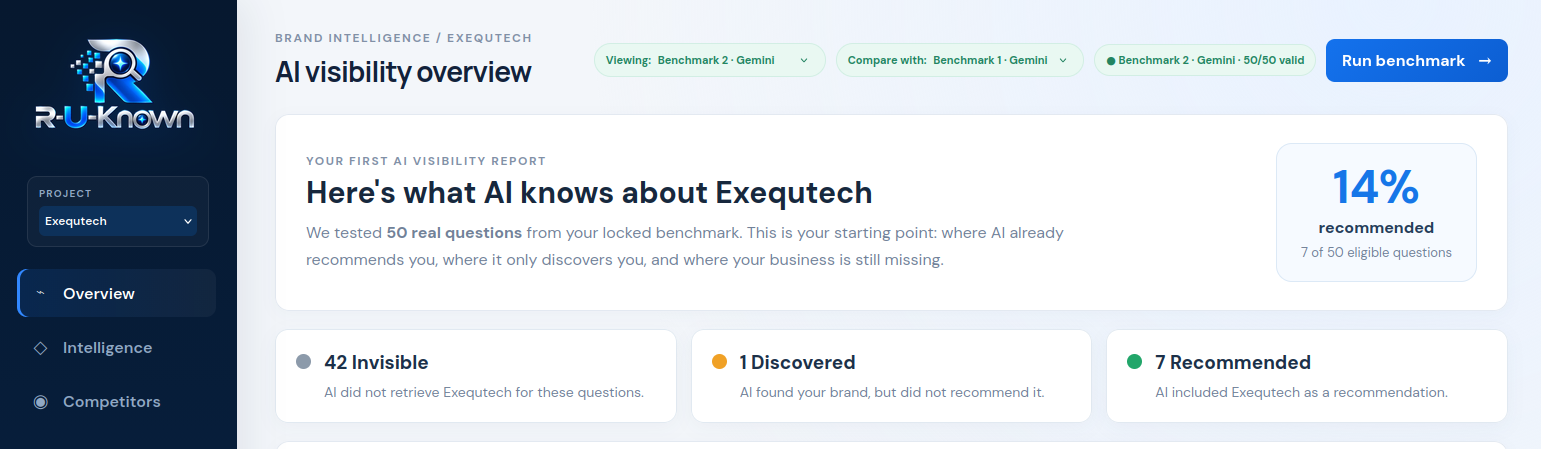
The first benchmark produced a recommendation rate of 14%: 7 of 50 eligible questions resulted in a recommendation.
That is the starting point.
But the real value appears when the benchmark is run again after changes have been made.
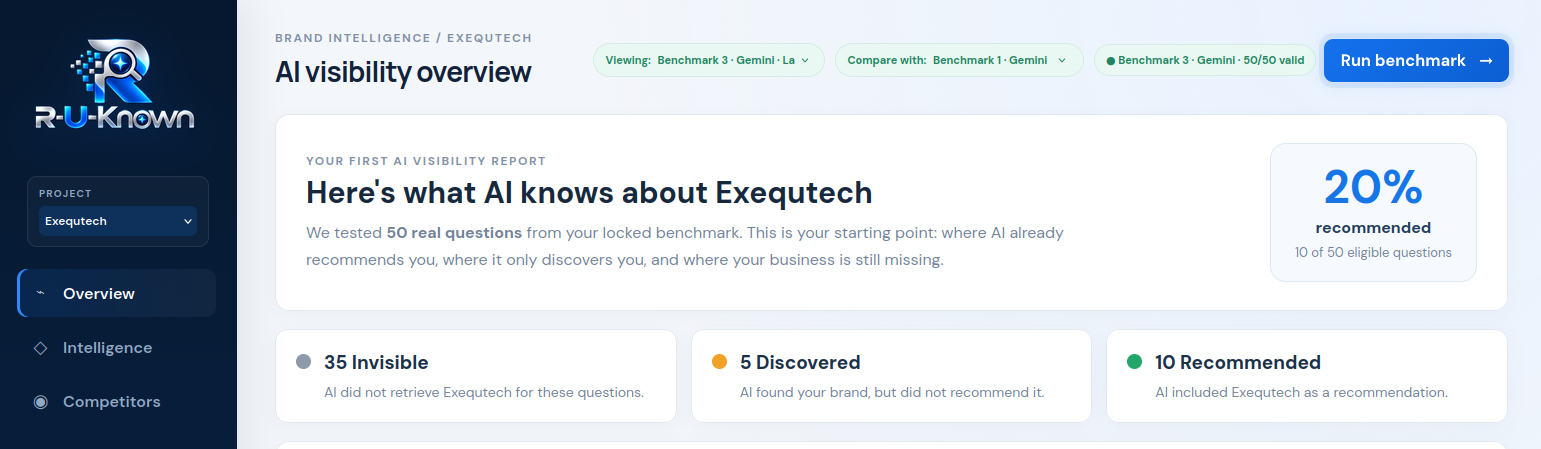
The second benchmark shows recommendation increasing from 7 to 10 questions — from 14% to 20%.
At the same time, Invisible questions dropped from 42 to 35, while Discovered questions increased from 1 to 5.
That is far more informative than simply saying, “Your AI visibility score increased by 6 percentage points.”
We can see how the movement happened.
1 Discovered → 5 Discovered
7 Recommended → 10 Recommended
Discovery is not recommendation
This is one of the most important distinctions in AI visibility.
An AI system might know a company exists. It might mention its name in an answer. It might even retrieve the company's website as a source.
None of those necessarily means the customer was told to choose that company.
For businesses competing for recommendations, the important question is not simply:
“Does AI know us?”
It is:
“When the customer asks who they should use, does AI recommend us?”
The evidence matters
A score without context is difficult to act on.
If a business is missing from an AI answer, the useful next question is why. If a competitor is being recommended instead, what information appears to be influencing that recommendation? Which pages, publications, directories, reviews, or other sources are being used?
This is why an AI visibility system should not stop at a dashboard number.
The report should lead back to the underlying evidence: the question, the AI response, the competitors that appeared, and the sources that contributed to the answer.
Measure → Act → Measure again
The purpose of benchmarking is not to create another monthly vanity metric.
The useful workflow is:
- Measure: establish where the business currently stands.
- Understand: investigate the questions, answers, competitors and sources.
- Act: make changes intended to improve the business's representation in AI.
- Measure again: run the same benchmark.
- Compare: determine whether the business moved from Invisible to Discovered or from Discovered to Recommended.
This turns AI visibility from something that is merely observed into something that can be investigated and measured over time.
What this means for agencies
For agencies working on SEO, content, digital PR, reputation, or GEO, this creates another useful reporting layer.
Instead of telling a client that “AI visibility improved,” an agency can show the actual movement and the evidence behind it.
That makes the conversation much easier:
Here is where you started.
Here is what AI could not find.
Here is what competitors were receiving instead.
Here is what we changed.
Here is what AI sees now.
AI visibility is becoming a measurable customer journey
The most useful way to think about AI visibility may not be as a single score at all.
It is a journey:
Invisible → Discovered → Recommended
And behind that journey are the questions customers ask, the answers AI generates, the competitors it chooses, and the sources it relies upon.
That is the problem R-U-Known is designed to investigate.
Ask what happens when your customers ask AI who they should use.
Conclusion
AI search is still developing rapidly, but one thing is already clear: traditional search visibility does not automatically translate into AI recommendation visibility.
Businesses need a way to establish a baseline, understand where they are missing, identify what AI is actually using as evidence, and measure whether their efforts change the outcome.
That is why we built R-U-Known around real customer questions and a locked benchmark.
50 questions. Real AI answers. Actual evidence. A measurable starting point.
And, most importantly, a way to find out whether your business is still invisible — or whether AI has started recommending you.
R-U-Known — AI visibility and GEO intelligence.
Visit ruknown.com
Contact R-U-Known
Tell us a little about what you would like to know, and we’ll get back to you.