 R-U-Known
 • AI Visibility Knowledge Hub
What Is Generative Engine Optimization (GEO)? A Practical Guide to Getting Found in AI Search
Generative engine optimization is the practice of making a brand and its useful information easier for AI-powered search experiences to discover, understand, retrieve and use when answering relevant questions. It does not replace SEO. It adds a new question: when an AI engine answers a buyer's question directly, is your brand part of that answer?
Why GEO matters now
Search is no longer always a list of ten links. Google AI Overviews and AI Mode, as well as conversational systems, can assemble an answer from multiple sources before a user decides whether to visit a website. In a 2025 Pew Research Center browsing study, 58% of the 900 U.S. adults observed encountered at least one Google search with an AI-generated summary. A 2026 Pew survey found 60% of U.S. adults said they read AI summaries at the top of search results.
GEO vs SEO: what actually changes?
| Traditional SEO question | GEO / AI visibility question |
|---|---|
| Where does my page rank? | Does the generated answer mention, cite or recommend my brand? |
| Which keywords bring traffic? | Which real-world questions trigger brand visibility? |
| Which page earned the click? | Which sources shaped the AI answer? |
| Who outranks me? | Which competitors are mentioned when I am absent? |
| How many organic visits converted? | How does AI visibility change across prompts, engines and time? |
Google itself says foundational SEO remains relevant to generative AI search. Its current guidance describes retrieval-augmented generation and query fan-out as mechanisms used in its generative search experiences, and recommends valuable, original, non-commodity content rather than special “GEO hacks.” That is an important guardrail: GEO should improve the usefulness and clarity of your web presence, not turn pages into text written for robots.
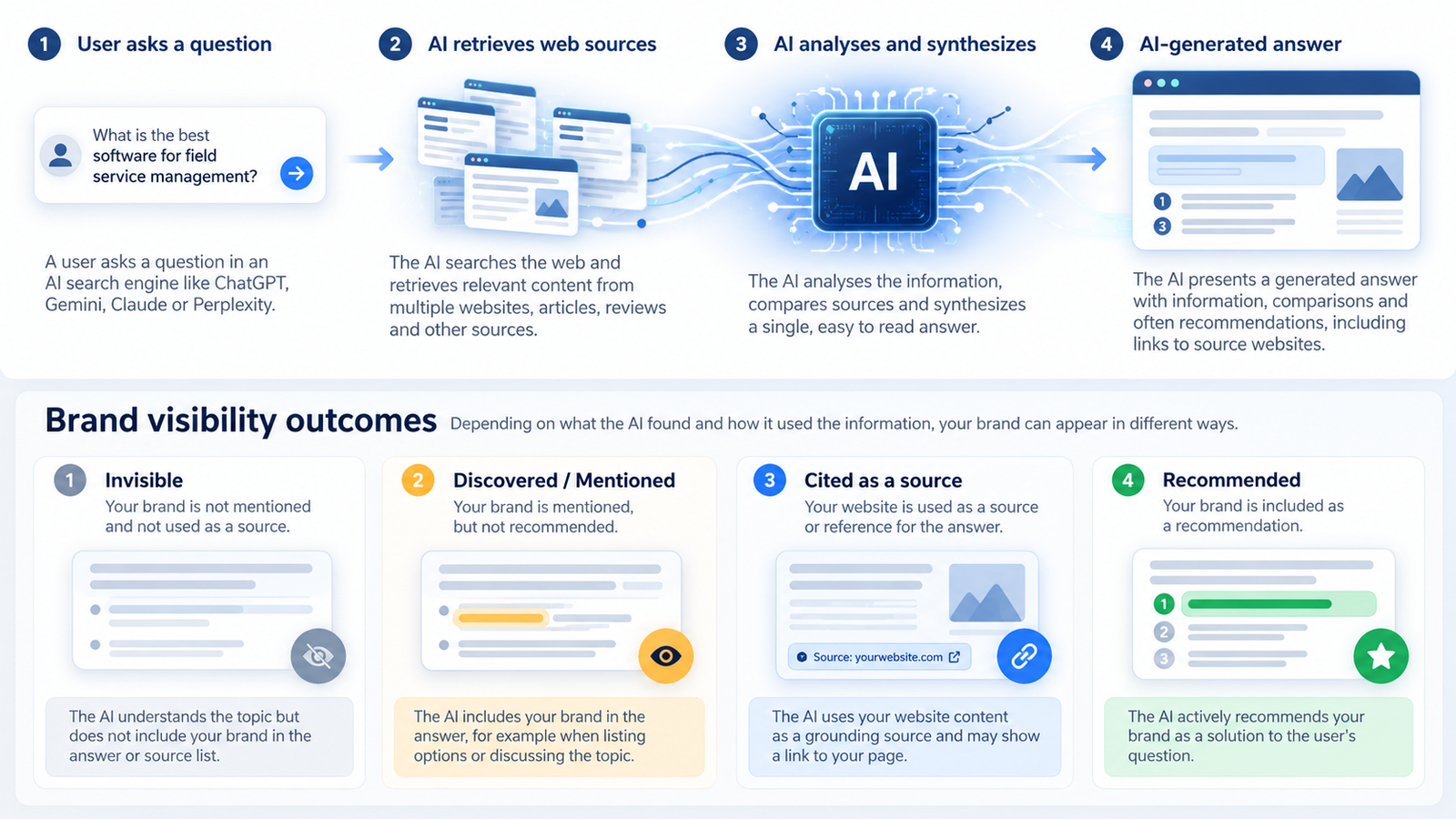
How generative search can discover a brand
A simple GEO visibility path
Make the entity, category and offering clear.
Publish useful pages that answer relevant questions.
Earn source and brand presence in generated answers.
Become relevant enough to appear in solution-oriented answers.
These stages are not guaranteed or perfectly linear. A website may be retrieved as a source without the brand being recommended. A brand may be mentioned from third-party information without its own website being cited. That is why AI visibility tracking should examine the evidence rather than reducing everything to a single rank.
What content tends to be useful for GEO?
Start with the questions your customers genuinely ask. Give a concise answer early, then provide the explanation, evidence, examples and limitations needed to make the page useful. Comparison content is valuable when it is factual and fair. Original research, first-hand observations, transparent methodology and clearly attributed statistics give a page information that cannot be recreated simply by paraphrasing everyone else.
Technical basics still matter. Pages should be indexable, accessible, fast enough to use, logically structured and internally linked. Google says a page must be indexed and eligible to appear with a snippet in Search to be eligible as a supporting link in AI Overviews or AI Mode.
What GEO is not
GEO is not repeating “AI search visibility” twenty times on a page. It is not publishing hundreds of thin AI-generated pages. It is not a guarantee that a particular model will cite you. AI answers can vary by engine, model, prompt wording, location, freshness and retrieval. Google explicitly warns against scaled AI content that adds little value and says there are no special technical requirements that magically unlock AI Overviews.
How do you know whether GEO is working?
This is where AI search monitoring becomes necessary. Define a stable set of questions that represent discovery, problems, comparisons, purchase decisions and brand checks. Run them consistently. Record whether the brand is invisible, mentioned, cited or recommended; which competitors appear; which pages are used as sources; and how those outcomes move between comparable benchmarks.
Five practical GEO steps
- Define the entity clearly. Use consistent company, product and category language across core pages.
- Build answer-worthy content. Cover the questions buyers ask before they know your brand.
- Add evidence. Use first-party data, examples, methodology, citations and appropriately sourced statistics.
- Build topical depth. Interlink related articles so a reader — and a retrieval system — can understand the subject around your product.
- Measure repeatedly. Track AI brand mentions, citations, competitors and source pages using a stable benchmark.
Frequently asked questions
Is GEO replacing SEO?
No. Google says SEO best practices remain foundational to its generative AI search features. GEO is best treated as an additional visibility and measurement layer.
Can GEO guarantee an AI recommendation?
No. Generated answers are probabilistic and depend on the question, model, available sources and other signals. GEO can improve clarity and discoverability; it cannot guarantee a particular answer.
What should a business track?
Track relevant prompts, AI brand mentions, citations, recommendation context, competitors, source pages and changes over time. That produces a more useful picture than counting mentions alone.