 R-U-Known
Measure real customer territory
Lock a meaningful question set around discovery, buying decisions and your market. See exactly where AI knows you — and where it loses you.
AI can’t find you? Find out why. Fix the gaps. Get R-U-Known.
Measure whether AI can find your brand, whether it actually recommends you, who wins when you don’t, and which web sources shape the answer. Then freeze the benchmark and prove what changed over time.
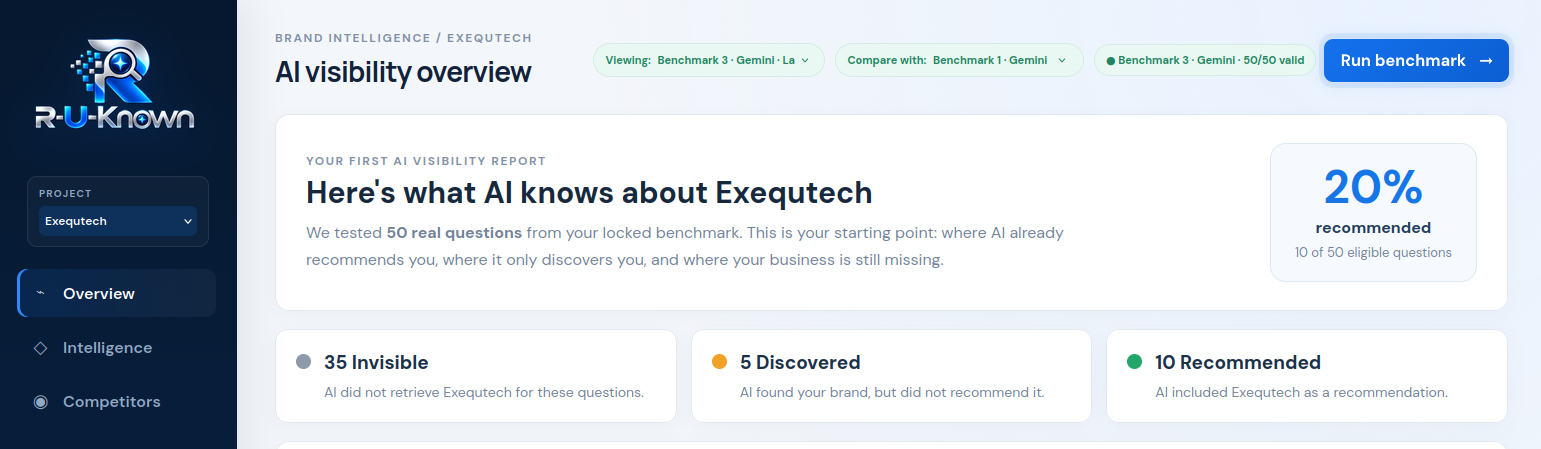
10 of 50 customer questions in a later benchmark
A mention is not a recommendation. R-U-Known separates being invisible, being discovered and being actively recommended — then preserves the answer, competitors and grounding evidence behind every result.
Lock a meaningful question set around discovery, buying decisions and your market. See exactly where AI knows you — and where it loses you.
See which competitors merely appear in an answer and which ones AI actually recommends. That difference changes the strategy.
Open the exact customer question, answer outcome, competing entities, diagnosis and grounding evidence behind the result.
Rank grounding domains and retain exact page-level URLs. See which sources repeatedly coincide with recommendations, invisibility or competitor presence.
Immutable snapshots reuse a comparable question set. Compare benchmarks without moving the goalposts and see what actually changed.
Surface the territories that deserve investigation next, backed by the exact questions, competitors and sources an SEO/GEO professional can inspect.
R-U-Known connects visibility, competitor behaviour, sources and benchmark movement so a score never has to stand on its own.
Record meaningful website, SEO, profile or visibility changes between immutable snapshots so movement has context.
R-U-Known follows the full AI visibility workflow: define the questions customers ask, benchmark the answers, understand the gaps, create the articles needed to improve visibility, prepare approved content for WordPress or GoHighLevel, with direct publishing and task tracking currently in progress.
Track searches about your services, category, and buying decisions.
Capture AI answers for the same questions so changes have useful context.
Open an answer, inspect the context, and find the pages connected to it.
Record change markers between runs, measure again, and show exactly where visibility moved.
Turn the questions, gaps, competitors and recommendations into prioritized actions your team can implement.
R-U-Known checks your existing website content and uses the gaps found in your benchmark to create targeted articles and content briefs. Review and edit the content directly in R-U-Known before publishing.
In progress: R-U-Known is being connected to WordPress and GoHighLevel so approved articles can be pushed directly to the customer’s website.
Every benchmark gives you more than a visibility score. R-U-Known analyzes the questions, AI answers, gaps, competitors, sources and recommendations, then turns those findings into a prioritized action plan your team can implement.
Understand where your brand appeared, where it was recommended, and what changed across the benchmark results.
Connect missed questions, competitor wins, weak recommendations and source gaps to the opportunities that matter most.
Use a focused plan to improve content, information and external visibility, then benchmark again to measure what moved.
R-U-Known analyzes the benchmark results, questions, gaps, competitors, sources and recommendations, then turns that evidence into an implementable Action Plan. After changes informed by the plan, a later benchmark showed more questions moving from invisible to discovered and recommended. The evidence is in the benchmark — not just the headline score.
Businesses need a way to establish a baseline, understand where they are missing, identify what AI is actually using as evidence, and measure whether their efforts change the outcome.
Read the full methodology story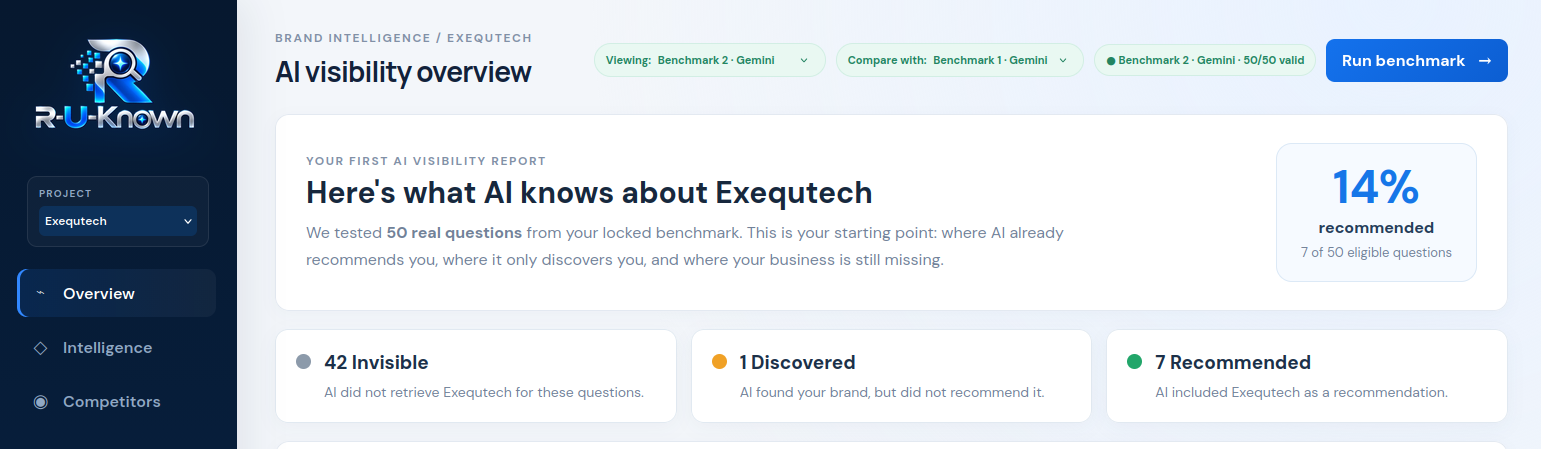
Understand what AI says about your business and how your presence compares with the companies customers also consider.
Bring AI search visibility into client conversations with answer level context, competitor insights, and repeatable tracking.
Every benchmark consists of 50 customer-relevant questions, creating a consistent baseline you can compare over time.
| Feature | Standard | Done For You |
|---|---|---|
| Initial Assessment | FREE | FREE |
| Price | $99/month | $249 managed assessment |
| Companies | One company | One company |
| Benchmark scope | Self-serve benchmarks | Managed assessment and reporting |
| Questions & benchmark management | Your team | R-U-Known |
| Analysis & Action Plan | Your team | R-U-Known |
| Results report | In-platform evidence | Client-ready report |
| Implementation support | Your team | Available on request |
| Feature | Agency | Agency Plus |
|---|---|---|
| Initial Assessment | FREE | FREE |
| Monthly Subscription | $379/month | $549/month |
| Companies | Unlimited | Unlimited |
| Total Monthly Benchmarks | 20 | 40 |
| Benchmark Frequency | Ad-hoc | Ad-hoc |
All prices are in USD. Initial Assessment is free; monthly subscription pricing applies after assessment.
No complicated dashboards. No credit conversions. Just answers.
Start with a free assessmentAI search visibility changes over time. The right measurement rhythm helps you separate meaningful movement from normal volatility.
No. GEO is very volatile, and tracking changes daily can lead you to make the wrong deductions and changes. It is better to observe change over at least a week, make a meaningful change, and then watch for another week. Web crawlers take time to pick up changes, so this cycle gives your updates time to be reflected in AI search answers.
Run benchmarks often enough to maintain a clear signal, but keep the question set consistent. A weekly or fortnightly rhythm usually gives changes enough time to settle before you interpret the results.
It shows whether AI can find your brand, whether it mentions or recommends you, which competitors appear, and which sources help shape the answer.
AI answers change. Keeping the question, answer, competitors and grounding pages lets you understand why visibility moved instead of reacting to a score without context.
Invisible means your business was not found in the AI answer or its supporting sources for that benchmark question. It doesn't mean your website cannot be found online — it means AI did not use or surface your business for that particular question.
Discovered means AI found evidence of your business or website. Mentioned means your brand appeared in the answer. Recommended means AI went further and presented your business as an option relevant to the user's question. R-U-Known keeps these separate because being found is not the same as being recommended.
AI search engines build answers using information they can discover and understand across the web. R-U-Known shows which competitors appear and the sources influencing those answers, helping you investigate why they are visible where you are not.
Yes. Where the AI provider supplies grounding or citation information, R-U-Known preserves those sources alongside the answer. This lets you see which pages and websites are helping shape the response instead of looking only at a visibility score.
No. AI search visibility isn't determined by your website alone. AI may rely on industry websites, directories, articles, discussions, reviews and other third-party sources when forming an answer. R-U-Known helps expose that wider information landscape.
R-U-Known analyzes the results, questions, gaps, recommendations and sources, then turns that evidence into an actionable plan your team can implement and measure.
No. A website can rank well in traditional search and still be absent from an AI-generated answer. Traditional SEO measures things such as search rankings and traffic; AI search visibility looks at whether AI systems discover, understand, mention, cite or recommend your business.
Yes. Keep your benchmark questions consistent, make meaningful changes, then run a later benchmark. Because R-U-Known preserves the earlier results, you can compare what changed in your visibility, competitors, answers and supporting sources.
Yes. When local targeting is relevant, you can define the service area for the business so benchmark questions reflect the locations and customers the business actually wants to reach.
One AI question gives you one answer at one moment. R-U-Known tests a consistent set of questions, analyses the results, records competitors and supporting sources, and preserves the evidence so you can compare it with future benchmarks.
Build a frozen baseline from the questions that matter. See the answers, competitors and sources. Make changes. Measure again. Prove what moved.
Work with usTell us a little about what you would like to know, and we’ll get back to you.